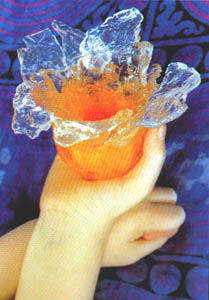
I heard a lecture by Joanna Margaret Paul on the dangers of genetic engineering and I woke from my slumber. Living in the Netherlands, in a society where issues such as this are rarely mentioned let alone discussed by the media, I'd just left this an an issue thinking I couldn't do much about anyway. I was wrong. Each of us, must 'digest' this.
As I see it there is no single answer but of us must research into this and it matters. I'd recommend reading: Cracking the Code by David Suzuki and Joseph Levine (1994) and the articles on genetic engineering in the NZ magazine Growing Today: May 1999, June 1999, July 1999.
The 5 works in this show are either a direct response to the issue of genetic engineering such as in the work, Five pointed star divided, which consists of texts arranged on 5 triangular pieces of cloth on the ceiling above, or existing art works which I have 'modified' for this exhibition.
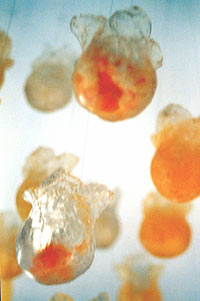
Another 'modified' work is a single tulip, from my Tulips from Istanbul installation with the following text about Dutch 1640's tulipmania placed underneath this.
"By the 1640s, when tulipmania was officially over, it was believed that only 12 bulbs of 'Semper Augustus' were still in existence, priced at 1,200 guilders each. And the flower itself had a unique trick. It could change colour, seemingly at will. A plain-coloured Councillor Hewart's red tulip, might emerge the following spring in a completely different guise, the petals feathered and flamed in intricate patterns of white and deep red.
Seventeenth-century tulip lovers could not know that these 'breaks' were caused by a virus spread by aphids. The virus was the joker in the tulip bed."
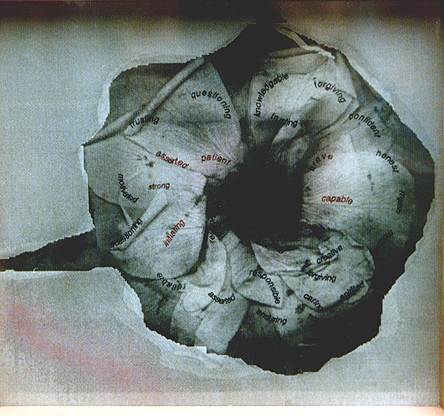
The work, The Virtue of the Rose
The 'virtues' describe human characteristics.
Next to the tulip and the text was the work: The
Virtue of the Rose with a text concerning bred flowers placed under this.
"The
most talked-about flowers in the industry in 1992 look innocent enough, and are unlikely to evoke exclamations of awe from recipients. From a distance, they seem to be little more than common white chrysanthemums.
Yet these particular white mums are the products of genetic engineering, and are said to exhibit a purer, 'whiter than white' display of petals than has ever been seen in their species.
Created through a collaboration between the Dutch company Florigene and the American company DNAP, they were welcomed into the cut-flower trade with great fanfare.
The patented plants that produce these blooms have been give a name that trumpets their developers' aspirations: Moneymaker."
p. 181 Cracking the Code, 1994,
David Suzuki & Joseph Levine.

Certain Measures, 2000
in the Blue Pacific Gallery,
Pataka Museum,
Porirua, New Zealand / Aotearoa.
Photo: Jill Studd.
My other pieces in this show relate more to the question of ethics and the idea of nature as a found object.
The five engraved sticks in Certain Measures are intended to encourage you to think about ethical issues.
In the transparency, Stars for feet, the child's foot is just coloured in. The genetic code of the child is not messed with. The issue of genetic engineering is not an easy one and the text informs us that "a latecomer has to deal with more."
Sonja van Kerkhoff, 2000
|
Keep off the grass was shown in: | |
| 2000 | Te Wa, W(h)anganui, Aotearoa | New Zealand, 5 - 30 November |
| 2000 | Artspace Gallery, Palmerston North, Aotearoa | New Zealand, 13 -28 October |
| 2000 | Blue Pacific Gallery, Pataka Museum, Porirua, (Wellington), Aotearoa | New Zealand, 24 September - 5 October |
