 Artwork by year Sonja's c.v. Sonja's Design page A tour via thumbnail images
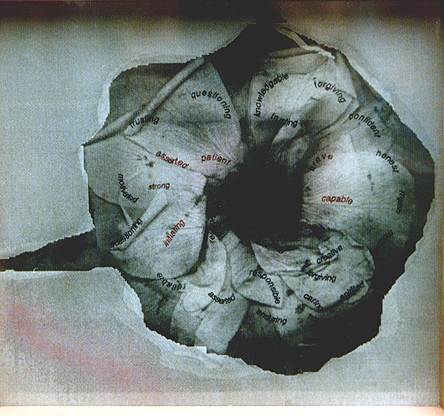
Detail
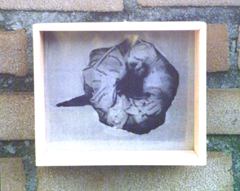
Computer print, with the text "Virtue of the Rose" engraved along inside of the frame,
18 x 20 x 4 cm.
'Virtu' is the old English form of the word virtue, and means the personal characteristics that give a person stature. I found it interesting that the word 'Virtue' now has the association of the (passively inherent) ideal or untarnished.
The rose is often portrayed as a symbol of ideal love, and I put the two ideas together, and in a sense anthropomorphised the rose by placing words over the image that are traits of human (perhaps ideal) character.
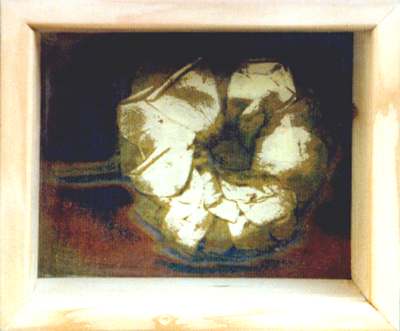
A version with a layer of glass and perspex which
shows reflections on the rose in this photo.
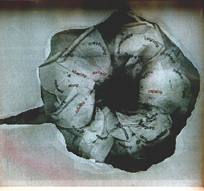
Right: Another version, without the texts
in the print. 18 x 20 x 4 cm.
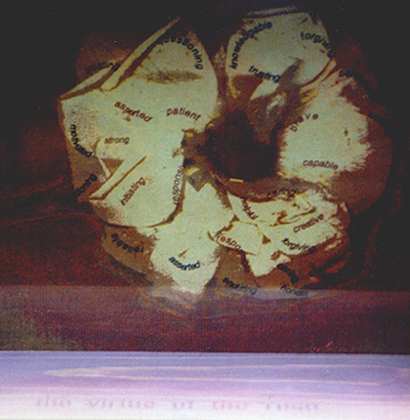
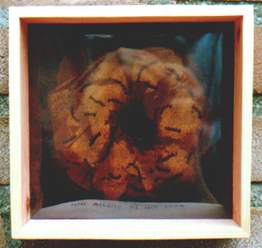
Detail of the centre of yet another version.
Below you can see the
engraved text
in the painted wooden frame.
(NB: The horizontal line is the reflection
of the bottom of the frame)
I was examining the associations between what we call an 'ideal' and what we call a 'characteristic', and in particular
I used the names of the Bahá'í months, such as ' Loftiness', 'Splendour', 'Questions', 'Words', etc, as starting points.
Our months, each nineteen days long, are also attributes for the divine. I took these words, changed some, added some others and placed them over the image of an open rose. The rose is a symbol of ideal love and for me, a fitting symbol for the divine, because in the Bahá'í writings, 'love' is repeatedly stated as the source of all things.
It is 'love' that attracts, and 'love' that inspires. Bahá'u'lláh wrote that his first counsel for us is to "Possess a pure kindly and radiant heart". I engraved the text "Virtue of the rose" into the deep frame to literally imbed it in the frame.
An Edition of 19
(including all variations).
In Private Collections in The Netherlands and New Zealand. Three are still for sale.
Het oud-Engelse woord 'Virtu' stelde een persoonlijke kenmerk voor die aan iemand waarde toekent. Ik vond het interessant dat het huidige ‘Virtue’ de associatie heeft van een passief ideaal dat van nature is, en van het onbezoedelde. De roos wordt vaak gebruikt als symbool van ideale liefde, en ik heb die twee ideeen samengevoegd en heb als het ware de roos gepersonificeerd door woorden op het beeld te plaatsen die horen bij een (wellicht ideaal) mens.
Ik maakte de associatie tussen wat wij ‘het ideale’ noemen en de persoonlijke kenmerken die waarde toekennen aan een persoon. Ik heb vooral gebruik gemaakt van de namen van de Bahai maanden, zoals ‘Verhevenheid’, ‘Barmhartigheid’, ‘Perfectie’ en ‘Vragen’. Onze maanden, van elk negentien dagen, zijn ook eigenschappen voor het ideale.
| |||||||||||||||||||||||||||
the medium |  | c.v. last things first |