Sonja van Kerkhoff

part two

            to part one             nederlandse versie          


Of Dutch and New Zealand heritage, I grew up on a dairy farm (1960) in Taranaki, Aotearoa / New Zealand. I left school to work in an abattoir (The Patea Freezing Works). I had to overcome the prejudices of my working class background and an unhappy childhood before I was brave enough to try art school. I was lucky. I am sure that this background was the main reason why I could never accept Abstract Expressionism as a way of working. My work has always been consciously informed by issues in the world around.

The cavity of the chest
aches under pressing stone,
the hills are as heavy as skulls.
Stressed bones constrain the hooked arch there.
In shadow, at the edge of night
the keystone bleeds.
Anger's geography,
bedrocked in distance.


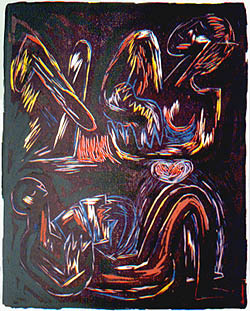
woodcut print by Sonja van Kerkhoff

Fire and Rain, woodcut, 1990,
50 x 70 cm. Edition of 17.

see: Prints by Sonja

These lines are from the poem New Vessels, (1987) written by Sen McGlinn.
Fire & Rain was one of a series of about 20 images that illustrated this epic poem.


painting by Sonja van Kerkhoff

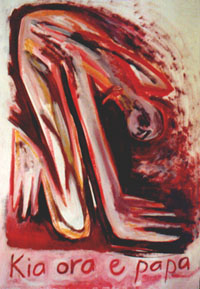
Greetings Mother, 1990,
acrylic on paper, 45 x 70 cm.

More Maatua
paintings
and prints


These Maatua were an adaption of the New Zealand Maaori poupou (ancestor) figures often carved vertically one under the other and recording the heritage of a people or sub-tribe. I used an isolated figure, in an ambiguous confined space where the tongue became a hand that both reaches and creates a (womb-like) space in front of the body.
Most people saw these as exotic monsters not to be taken seriously.

I got sick of them being called monsters, and so I stopped making them and began using text more directly in my work.


Greetings Mother!, was another image was in this series. And the painting illustrated here was a reworking of my homesickness for things Maaori. Here in the Netherlands people walk on the land controlling it and containing it. In Aotearoa (New Zealand) we personify the land. Papatuanuki is our mother.

earth turns,
inclines her axis,
plough fields and snow fields
groan and begin.


From New Vessels, the book.


My first works in the Netherlands were responses to the psychologicaland spiritual coldness I felt here. My He Matua (Parent) images screamed became angrier and angrier. Screaming for contact daring you to look at them in the eye. I was surprised at how angry they were and how hard I found it to live here. They were also direct responses to the feeling that I had to paint like a man to be taken seriously by my tutors. I was even instructed by the painting tutors to paint with a large paintbrush and to paint objectively!
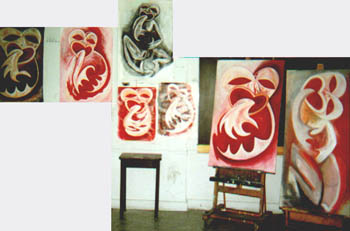

paintings by Sonja van Kerkhoff

He Maatua (Ancesters / Guardians),
artschool studio view, 1989. Acrylic on canvas or paper.
From 200 x 50 cm until 70 x 50 cm. 

More Maatua paintings and prints


More images from this series


I used words to challenge the idea of objectivity, and to tell my story.

And the sky returned to its proper place, is a lithograph of a screaming woman.
The text in the shadow below reads:

"Bugger off", shouted Chicken Little,
and the sky returned to its proper place.


I was angry at the blatant sexism of the painting department (and each year the women 'dropped' out until only two of us were left in the final year), and I deliberately used the chicken / egg symbols to give the story a twist as well as using imagery, colours and forms, that had been termed as 'subjective' by my tutors.
I was fighting the idea of the 'universal' as preached by my tutors. It was hard because no one around me seemed to see what I was doing.

My work was called feminist as if that was an insult, and dismissed.

Reading feminist literature kept me sane.


see Latency see Eva was hier
see A Wild animal feeds her young.

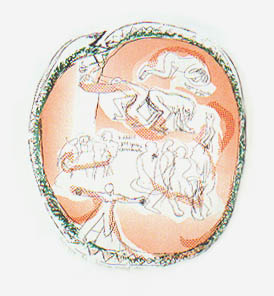
The snake forms the boundary -the world- or history. But the fluid lines seem as if they could move at any moment. The women are and seem contained while one steps on the boundary.

More prints on similiar themes.

print by Sonja van Kerkhoff

Eve's Apple, 1992.
Lithograph and silkscreen print on paper.
25 cm in diameter. Edition of 15.


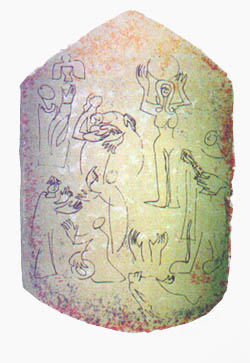
All art carries a message, as does history. For example In the print, Carrying a Message (on the left), a figure enters the house-shaped space carrying the words, "Carrying a message" and it is intended to be read tongue-in-cheek.

The use of thin graceful lines and soft colours give a sense of the poetic while the cartoon-like figuration, and the choice of subject matter, add a touch of humour.

Various messages (with religious overtones) are suggested in the drawings of a woman holding up a circle, the priest holding up the host, a lying (dying) figure, the kneeling figure, or in the two gesturing figures.

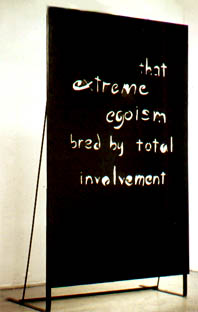
In the autumn of 1990 I took a canvas, tarred it, and cut out the words:

"That extreme egoism bred by total involvement".

That was what I thought of the tutors' attitudes about making 'independent' art. I even gave it "legs" so that it could stand on its own 'feet'. For my graduation exhibition I dispensed with the object and projected a slide of the text above a doorway.

I realised during this struggle to be taken seriously that dialogue in the art world (whatever that really means) was important to me. And I realise now that much of my anguish was due to isolation and a lack of dialogue.
I am now not so worried about showing my more figure work along side my more text-based work.
There is no need to prove my professional status by a display of consistency.
Context and presentation are important, but
"...consistency is the fetish of small minds."

(Mark Twain)

art by Sonja van Kerkhoff


Other art incorporating text
Sculpture
Painting

Sonja van Kerkhoff

part three

            to part one             nederlandse versie  


My investigations about self and object, subjectivity and objectivity, have led me to work in varying media, and often a combination of various media.

The Subject has the text:

The subject
accidently encounters
the original

silkscreened onto a mirror which fits inside a white shoe.

The shoe rests on a piece of transparent perspex. The surface of the perspex is rippled and holds the shoe at an angle so that as the viewer looks down to read the text, they see their own face in the mirror.


object-sculpture by Sonja van Kerkhoff

The Subject, 1992,
shoe size, silkscreen on mirror,
shoe on transparent perspex.
To other views of this work

sculpture incorporating a custom made table by Sonja van Kerkhoff

Bijzetafel, 1992,
85 x 55 x 37 cm.
Silkscreen under glass,
and custom made wooden table.

Larger view (39 KB)


The text was really about the subjectivity of storytelling, and that's why I wrote a story around the edge of this art object. The text mixed my personal fears, struggles and realizations with the event of the fall of the Berlin wall, as well as in overcoming the obstacles of expressing myself 'objectively'!
What I hadn't anticipated was that people would walk around the table to read the text.
It had a dizzying effect!

Bijzetafel (Side table or coffee table), is a silkscreen print under glass as part of a purpose-made table. The print shows two laughing women, with one holding out her hand towards two dragon-dogs on leads. Around the edge, the text reads:

"don't worry", she laughed, "he won't bite and if he does it won't be nearly as painful as the thought of it." "What a joke", I thought being frightened when it was obvious that even the machinery was rusting let alone the question of whether the parts were connected or not. But all the same it's strange holding out your palm upwards in a gesture that the old fools couldn't see. No one knew how long ago they had lost their sight. For decades no one had noticed that the gestures hadn't changed. They continued their customs while the garden diversified and multiplied. Then one day, the walls fell down and we could see. "It's funny how things have turned out," she grinned.

batiked cloth sculpture by Sonja van Kerkhoff

A tangled tale
1997,
55 x 55 x 200 cm.
batik text on
cloth strips.

other views of
A Tangled Tale

Using various media suits my aim in stimulating people to look at a situation from another viewpoint while integrating the spiritual, conceptual and physical into the 'essence' of how the work is experienced. For example, in the work A Tangled Tale, the participant has to plunge her hand among the waxy strips to select from the texts, which are in the three languages which I speak. I used approximately 100 one and half metre strips from old sheets, and batiked stories about physical and metaphorical journeys along them. The languages and modes of language get tangled and are interwoven as they emerge, yet each story or strip is coherent in itself.

People are invited to handle these strips but the two readings of the form as either a tail or a head of hair are intended to create an uneasy feeling about touching the work. But they have to, to read the texts. The work is a tale of journeys, without beginning or end, familiar but partly incomprehensible.

Touching and sense are as integral as the enigmatic nature of the texts.

Sonja van Kerkhoff

part three

            to part one             nederlandse versie  

In 1994 I started work on a series of drawings which I now call the "Essences and Particularities Series".

If there is a mantra in the Bahá'í community, then it is ´unity in diversity´.

These drawings are an exploration of the diversity, the ´differend´so to speak, but unlike Lyotard who ended up trusting no stories, I found that in focussing on the particular (what was exceptional for me), I discovered more stories. It seemed that by listening more and not worrying about whether something made sense or not, I discovered new words / worlds.

This is a series or theme that I continue to explore in various media.

View more images


In 1994 I made a 6 minute video, where these mythopoeic drawings constantly metamorphasize while a choir sing in medieval style.

View stills

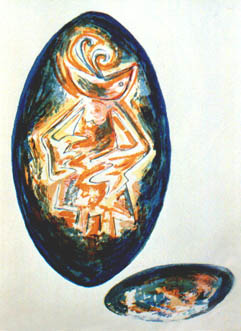
Players, Computer manipulated drawing, 1999, by Sonja van Kerkhoff

Players, 1999,
15 x 20 cm.
Computer Print on paper.
Limited Edition of 19.

We tend to think of universals as being what connects us to God or to our soul.

"When thou doest contemlate the innermost essence of things and the individuality of each, thou wilt behold the signs of they Lord's mercy..."

´Abdu´l-Bahá     (Sel. from the Writings of ´Abdu´l-Bahá, p. 41)

These drawings made and still being made in this series connect within the same 'expanding' artwork. They relate directly to my identity as a Bahá'í.

Sometimes I use a title to give an accent on the spiritual, other times on the political, such as in the works titled: Containers, Sleep or Martyrdom.

Sonja van Kerkhoff

part five

            to part one             nederlandse versie  


In the words of Bahá'u'lláh,


"Justice is the best beloved of all things".


My photo/text pieces, Give and Take and The consequences deal with this. The apple could be 'the snare', the material that is either trapped or possessed but for me it is the 'giving and taking' that is really the trap: our motive.

I chose a postcard as the form for this artwork because postcards are things often given and received. Often as souveinirs of exchange rather than as objects in themselves.
It is open ended whether the apple is given or taken, mirrored or doubled, or the child's part in the transaction.

For me, justice, is about everyday acts, and not so much about heroic moments. What happens when you give and take? Is that compromise or wisdom. Is that what justice means? Is the child giving or taking, owning or offering?


Give and Take, 1995,
postcard, 10 x 15 cm.
Edition of 3000.

Stocks are limited.
See postcards  


Text on the card:

"Make not your deeds as snares
to entrap the object of your aspiration"


Bahá'u'lláh, Kitabi-i-Aqdás.

The text warns us to consider our motives, particularly when we do something nice for someone. It warns of making something that is essentially spiritual (trust / manaakitanga) into a possession, but that emphasis is on the positive: it just says, be careful about your motive when you give. It's ironic that we often think of justice in the context of injustice.


print by Sonja van Kerkhoff


The consequences, 1998,
computer print, 10 x 15 cm.

Text: the consequences of telling the truth
are as dire as those of lying.


In The consequences, a man kisses a baby, and the text warns us that telling the truth is as risky as telling lies. By presenting this 'saying' in this manner, the viewer is encouraged to question what is meant by 'truth', and where is the 'risk' in what seems a harmless ordinary act.

The text comes from the novel,
To the Is-land
by the New Zealand author, Janet Frame.


In both pieces I deal with the issue of justice from the perspective of ethics and questions, because justice, at least in this day and age, is much more complicated than the principle of an 'eye for an eye'.

>>Next page of this article    Latest Work    Arranged by Medium    Sonja's c.v.    Sonja's homepage