 Artwork by year Sonja's c.v. Sonja's Design page A tour via thumbnail images
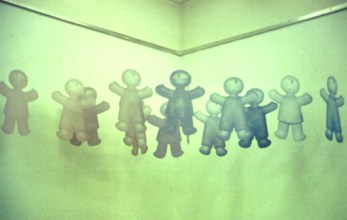
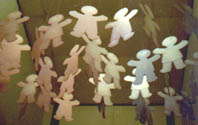
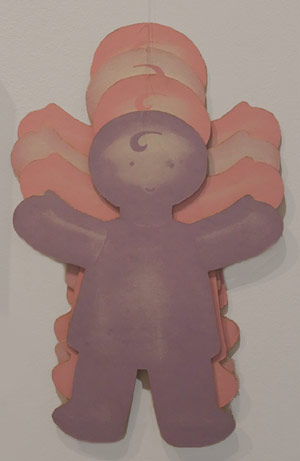
Silkscreen printed cardboard dolls
in gradual shades from pink to blue.
Each doll is 50 cm long.
Sexuality like identity
does not have a rigid border.
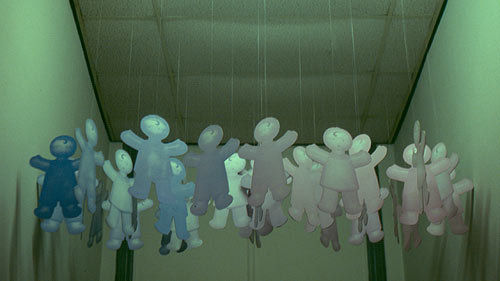
These dolls are copies of a toy made out of a pair of plastic dolls given to me for my baby. It was a pink and a blue doll joined at the head by string.
Until I had a baby with an indeterminate name, whose sex I did not willingly reveal, I had never realised that so many people around me took these 'lessons' about the distinctiveness of gender so deadly seriously. These encounters were the inspiration for this work about how we 'learn' to see gender and related to that identity and sexuality.
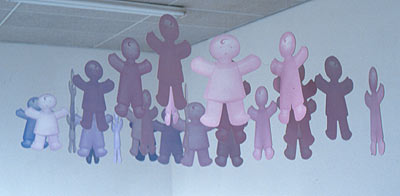
<< Click to for larger view (38 kb) in a new window of this
in the Oceania exhibition, June 2004.
So I hung these dolls high up to simulate the baby's view from a bassinet. Except here the colours and the forms present sexuality as a continuum.
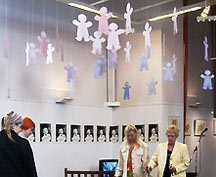
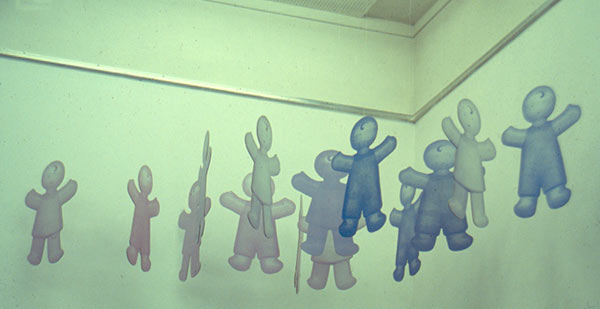

View of the Oceania exhibition, June 2004, Urmond, The Netherlands.
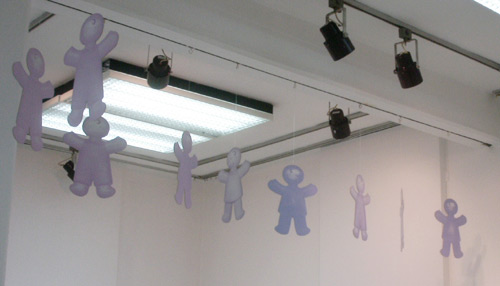
In the Far Near Neighbours exhibition,
2005 Sarajevo Winter Festival, New Temple Gallery, Sarajevo,
Bosnia-Herzegovina.
Statement for the Far Neighbours exhibition
February 2005
Calling another a neighbour, whether far or close, is about the relationships we have with each other.
Much of my work relates to the theme of human relationships, such as in First Lessons in Relativity where dolls in various shades from pink to blue hang above the viewer. The dolls refer to one's first lessons in socialisation. The first time we relate to a neighbour, perhaps?
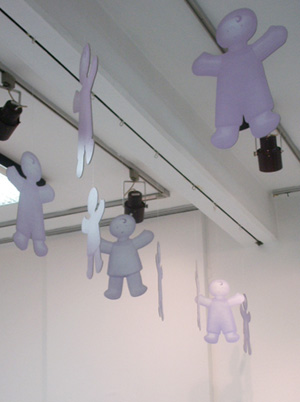
In the Far Near Neighbours exhibition,
2005 Sarajevo Winter Festival,
New Temple Gallery, Sarajevo,
Bosnia-Herzegovina.
These dolls hover above, out of reach, but definitely for viewing, much like toys are hung above a new-born's bassinet. The dolls are identical in form, to show our commonality, and the changes are subtle. Identity like gender does not have rigid borders.
Tulips from Istanbul is another hanging installation, this time of translucent tulip forms in various shades of orange. They are accompanied by a text from the Quran:
"It is not a tale invented but a confirmation of what went on before it..."
and by a historical statement:
"The Dutch House of Orange has reigned since 1572. The tulip from Turkey gained popularity in West Europe in the early 1600s."
The Tulip, now a Dutch cultural symbol, migrated to the 'west' from an Islamic culture. Orange, now the colour associated with being Dutch, originated in France and reached us via various German Dukedoms. I hung these tulips so that we look up at them (from another perspective). They are in constant, often barely perceptible, motion. This cultural symbol is a by-product of exchange and migration, and is not something 'set in concrete'. As the quotation from the Quran states: It is not new but another appearance of what already exists.
The work An Inland soul at sea, consists of suspended forms that seems like suspended islands or boats of light.
The sound that accompanies this incorporates music by Brenda Liddiard & Mark Laurant (New Zealand) and Ben Koen & Joe Fiedler (U.S.A.).
The music, like the suspended forms, seems to fluctuate between abstraction and the descriptive. There are sounds that seem sea-like and phrases that are dominated by rhythm. The title comes from a phrase in a poem by the American Emily Dickinson, in which she spoke of feeling lost or out of place. I took this idea of the 'different entrapped in something else' and made a fleet. Here these are 'souls' of the far and near.
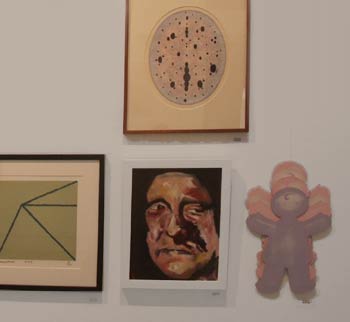
In the Cafe Gallery Open exhibition,
2009, London, U.K.
|
| |
| 2012 | OpenMakers Aalmarkt Studio, Leiden, The Netherlands |
| 2009 | Cafe Gallery, London, U.K. |
| 2009 | Arts Festival Arcade Art Project, Carlisle, U.K. |
| 2005 | Far Near Neighbours, Saravego Winter Festival XX, Saravego Winter Festival, Bosnia-Herzegovina |
| 2004 | Oceania, Terpkerk, Urmond Terp Church (now used as an art gallery), Urmond, The Netherlands. |
| 1993 | Group Show, Arti, The Hague, The Netherlands |
| 1992 | Graduation Exhibition, Academy of Visual Arts, Maastricht, The Netherlands |
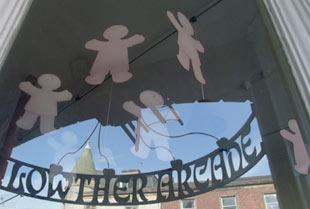
In the Carlisle Arts Festival exhibition,
2009 Carlisle, U.K.